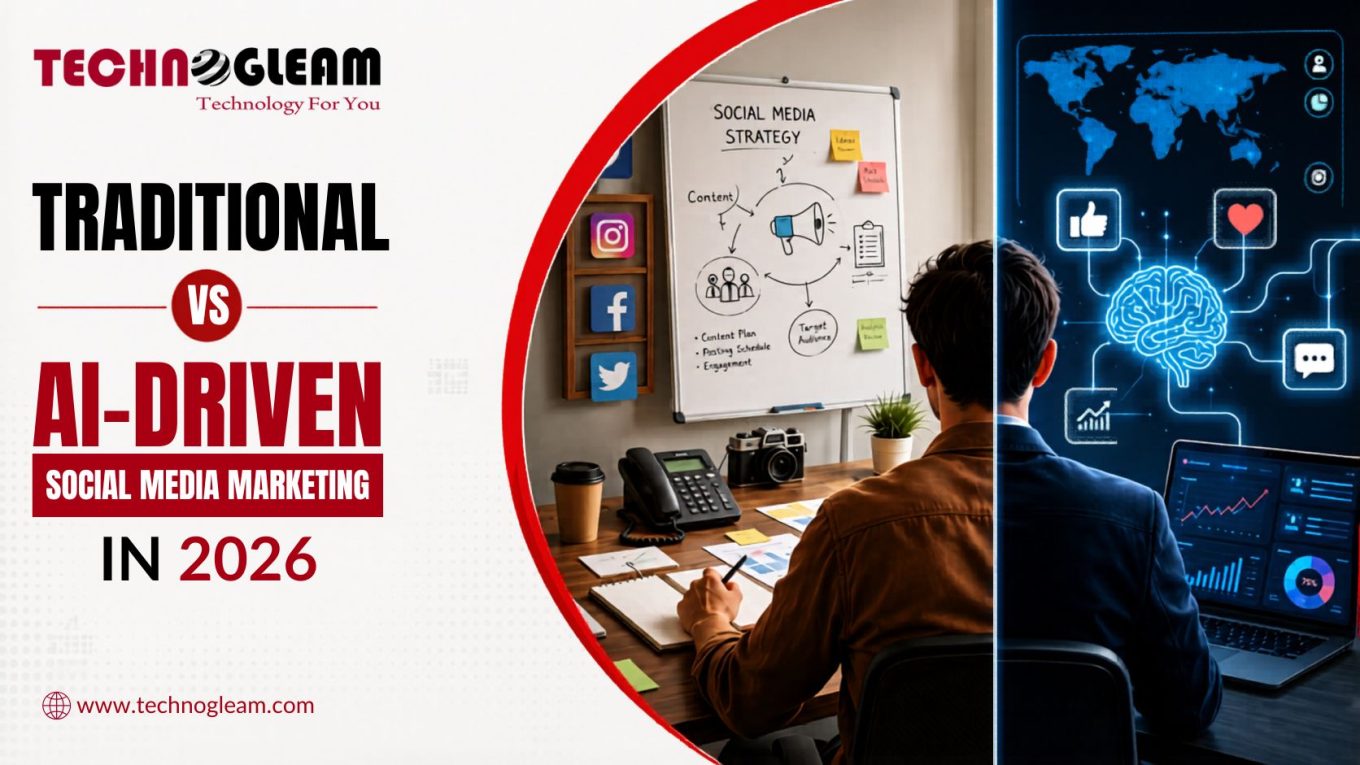
Traditional vs AI-Driven Social Media Marketing in 2026
Today, as an owner of a business, you have probably had the term “ social media marketing” thrown at you a thousand times. However, just what is social media marketing, and what is its significance?
In simple terms, social media marketing means how you are going to market your business with the help of social media such as Facebook, Instagram, LinkedIn, YouTube, and many more. It contains every little aspect, ranging from posting photos and videos to doing paid social media campaigns to replying to comments and messages of the customers.
An Effective Social Media Marketing Campaign can Assist Your Company to:
- Create brand awareness through social media and penetrate the correct audience.
- Connect and develop relationships and trust with your audience.
- Get traffic to your site and convert followers to customers.
- Be the Authority in your space, and vanquish your competition.
- Conduct successful paid social media campaigns and get a payoff.
Whether you have a small retail store in Siliguri or a hotel business that wants to reach out to your customers across the globe, social media enables you to reach out to your customers. You do not have to spend an enormous budget using traditional advertising through conventional media.
This is exactly why social media marketing has become a necessity.
The Evolution of Social Media: From Simple Posts to Smart Platforms
Where is social media marketing headed? It’s a big question, but to help answer that, it is useful to know how it got to this point.
Early 2000s – The First
Social media began as a means through which people used to communicate with friends and relatives. Social networks such as Orkut, MySpace, and an early version of Facebook were exclusively personal. Businesses had no role in it yet.
2008–2012 – Brands Enter the Scene
Businesses started paying attention as Facebook and Twitter have hundreds of millions of users. Brand pages launched. Corporations began updating and making additions of promotional material. This was the inception of organic social media marketing – appearing free of charge and developing an audience naturally by performing regular postings.
2012–2016 -The Rise of Paid Social Marketing
The organic reach began to decrease. Facebook and Instagram began limiting how many of your followers actually saw your posts unless you paid to promote them. Advertisement using social media has gained importance as an industry.
2016-2020 – Video, Stories Rising
Video content exploded. Instagram Stories, Facebook Live, and subsequent YouTube Shorts transformed the way brands talked. Influencer marketing has become a strong tool to connect with specific audiences using credible voices. Social media content shifted toward shorter, faster, more visual formats.
2020-Present – The AI Revolution
This is where the real fun begins- and where the largest change in the history of social media marketing is taking place. Artificial intelligence came onto the scene. Platforms began to use AI to select the content to display to users. And marketers started to apply AI to generate content, data analysis, automation, and personalisation of campaigns.
This all brings us to the burning question of today: Should you stick with traditional social media marketing – or shift to an AI-driven approach?
Contemporary Trends Shaping Social Media Marketing in 2026
Various trends actually outline social media marketing to date. Let’s have a look at the various trends shaping social media marketing in 2026.
Short-form video is dominating: Reels, shorts, TikTok videos now consistently outperform. They are used in every other format for reach and engagement. If short videos are not on your content marketing strategy, then you’re leaving reach and money on the table.
AI is embedded in all the major platforms: Instagram’s algorithm, Facebook’s ad delivery system, LinkedIn’s content ranking system – these are all AI-driven systems today in digital marketing. So the marketers, who understand AI, have a benefit and will succeed.
Personalisation: Personalisation is no longer a bonus – it’s expected. We no longer react positively to generic content. Now the audience expects to be spoken to directly, to see the content that relates to them personally, that talks about their needs and stage in life. AI helps to achieve even for a small business.
Social commerce is blooming: Consumers can find and buy items on social media platforms without ever leaving them. Shops on Instagram, Facebook Marketplace, and Pinterest shopping are growing exponentially to be major sales channels.
Creator/Influencer content: Human-looking content-real people, real stories, and real opinions-always beats slick brand ads. Authentic content is now the biggest currency on social media platforms.
Data privacy is changing: Cookie-based targeting is being phased out. Platforms are developing new ways to target audiences based on first-party data. Smart, compliant ways to reach the right people are now necessary.
Community is the next game-winner: Rather than accumulating followers, the leading brands build real communities around their brands and products. Loyal communities drive word-of-mouth, loyalty, and future success at a far higher level than large, passive following groups.
Comparison: Traditional vs AI-Driven Social Media Marketing
Now for the heart of this blog: understanding the real differences between the two approaches, Traditional vs AI-Driven Social Media Marketing. We will understand each one does well, where each one falls short, and what it all means for your business.
1. How content is created
Originally, all the marketing content is created by human beings, and a copywriter would collaborate with a designer or a videographer, coming up with a creative idea which can perfectly represent the brand. The generated copy would be creative, full of emotion and human touches. But this way is time-consuming and high-cost when in the quantity.
AI shifts this equation entirely. It is now possible to generate captions, hashtags, and even draft content in seconds using tools like ChatGPT, Jasper, and Canva AI, and to scale one piece of content into a number of iterations. However, without human oversight and editing, the output of AI can be generic and lack soul.
- Traditional: High creativity, High Cost, Slow Production
- AI-driven: High Speed, High Volume, Requires Human Review
- Best Approach: Leverage AI to draft and scale, humans for refining and elevating
2. How the Audience is Understood and Targeted
Traditional audience targeting involves the use of painstakingly constructed audience personas derived from surveys, research and competitor analysis. An experienced marketer might know this perfectly, but humans have only so many resources available.
AI is able to look through thousands of data points simultaneously, detect patterns, anticipate interaction and then change the target in real-time. Facebook and Instagram already run on complex AI systems that determine precisely who to show content to.
- Traditional: Manual Research, Experience-Based, Qualitative Insight
- AI-driven: Data-Driven, Precise, Continuously Optimised
- Best Approach: Combine AI’s quantitative strengths with the human’s nuanced cultural and contextual understanding
3. How Posting and Scheduling are Managed
Traditional posting is a process of manually logging in, uploading, writing a caption, and then scheduling for one platform at a time. The schedule is driven by a general posting guide. For one or two platforms, this might be manageable, but it is incredibly time-consuming across four or five.
AI-powered automation can take this much further; not only will it post on your selected platforms simultaneously, but it can also tell you exactly when to post them based on your target audience, and can even A/B test different post formats for you, all with no manual intervention.
- Traditional: Manual, labour-intensive, generic timings
- AI-driven: Automated, behaviour-based timing, push to all simultaneously
- Best approach: Automate the routine with AI, keep human eyes on quality
4. How Performance is Monitored and Analysed
Traditional monitoring of performance has always involved extracting all the reports and copying and pasting them into a spreadsheet, and analyzing at the end of the month. It is important data, but it’s always looking backwards, and when you’ve actioned the data, it’s already too late.
AI performance data provides real-time monitoring with predictive analysis; it tells you if posts are not working within a few hours of you pushing them live, and it shows you what types of content get the best engagement, with all platforms monitored via one live feed.
- Traditional: Historical data, manual data pulling, platform-specific reports
- AI-driven: Real-time and predictive analysis, real-time single interface
- Best approach: Use AI analytics to act fast, use human judgment to interpret meaning
5. How Personalisation and Customer Interaction Work
Traditional social media is fundamentally one-to-many – one message, sent to everyone. Conversations, responses, and messages are all manual and are a great way to build authentic connections, but there’s simply no way it can scale-things are bound to fall through the cracks.
AI allows for one-to-one personalisation, but at scale. Chatbots handle the most common questions on a 24/7 basis. AI personalises the content each user sees based on their behavior, and even allows for dynamic ad creatives that adjust automatically to different audience segments.
- Traditional: One-to-many, broadcasted content, manual responses, authentic, unscalable
- AI-driven: One-to-one, personalised content at scale, 24/7 chatbot support, dynamic ad creative, adaptive to different audience segments
- Best approach: Use AI for volume, human for depth
6. Cost and Resource Requirements
Traditional social media has real ongoing costs-salaries, freelancers, design software, and production budget. A full-stack social media team is expensive to hire and maintain, particularly for smaller companies.
AI tools decrease the cost per output significantly. A single person would use tools able to accomplish the work that three or four would normally take. It still does require human oversight, however, from defining strategy and reviewing output to maintaining brand tone.
- Traditional: Higher ongoing costs, requires more employees
- AI-driven: Lower cost per output, potential for a smaller, lean team
- Best approach: Use AI to augment small teams’ capabilities, rather than replace human effort entirely.
7. Creativity and Brand Voice
This one’s not close. Human marketers offer a knowledge of culture, an emotional intelligence, a storytelling feel, and the intuitive ability that makes a brand feel like itself. AI can approximate brand voice when prompted correctly, and is excellent for large-scale content consistency. But genuine new ideas for a campaign, real wit or a story that truly alters someone’s perception. That’s from people.
- Traditional: Strong on creativity, original concepts, brand soul
- AI-driven: Consistent, scalable, capable, rarely inspired on its own
- Best Approach: Humans develop a creative strategy, define brand voice; AI then scales effective executions.
A Quick Comparison
Now let’s have a quick look on comparison between Traditional vs AI-Driven Social Media Marketing
| What We Are Comparing | Traditional Social Media Marketing | AI-Driven Social Media Marketing |
| Content Creation | Human-led, creative, time-intensive | Fast, scalable, needs human refinement |
| Audience Targeting | Manual, experience-based | Data-driven, precise, real-time |
| Posting & Scheduling | Manual or basic tools | Automated, behaviour-based timing |
| Performance Analysis | Retrospective, manual reporting | Real-time, predictive, actionable |
| Personalisation | One-to-many broadcast | One-to-one at scale |
| Cost | Higher human resource cost | Lower cost per output |
| Creativity & Brand Voice | Strongest here | Competent, rarely brilliant alone |
| Best For | Deep brand storytelling, complex strategy | High-volume, data-driven execution |
Which Approach Is Right for Your Business?
Here is the honest answer: Neither approach alone is the right answer in 2026. Therefore, Traditional vs AI-Driven Social Media Marketing shows that it is not possible to thrive with a singular approach.
Right now, the winning social media brands aren’t choosing one or the other, between tradition and AI. They’re using both AI to execute fast and to scale with data insight, and human intelligence to take strategy, the creative and a real human connection.
Think of it this way: AI is an exceptionally powerful tool. But a tool still needs someone who knows how to use it well.
A social media campaign built entirely by AI, without human strategy and creative input, tends to feel hollow and generic – audiences can often sense it. But a social media campaign built entirely by hand, without the support of AI data and automation, is slow, expensive, and increasingly difficult to scale in a competitive landscape.
The future of social media marketing is human intelligence guided by artificial intelligence.
How Technogleam Approaches Social Media Marketing
At Technogleam we don’t pick sides on the Traditional vs AI-Driven Social Media Marketing, because the reality is that the best results are a hybrid of when to use each.
At Technogleam, we don’t just post content – we build strategies that turn scrollers into customers.
Here’s how we do it:
Strategy First: No guesswork. No shortcuts. We start by understanding your audience – who they are, what they care about, and where they spend their time online – before a single post goes live.
Creativity That Engages:
Our copywriters, designers, and content creators work together to build campaigns that feel genuinely human.
- Real stories that resonate
- Creative executions rooted in your brand’s core
- Content that speaks directly to the people you want to reach
AI & Automation for Scale Once we know what works, we scale it intelligently:
- Post at peak engagement times
- Target specific audiences with precision
- Optimise campaigns continuously using real-time data
The Result? A social media strategy that is both creative and data-driven -building real brand awareness, driving genuine engagement, and delivering sustainable business growth.
Frequently Asked Questions (FAQs)
Traditional social media marketing is all about the human hand in creativity, manually scheduled posts, and knowledge-based decisions. AI-driven social media marketing leverages AI to automate content generation, optimize scheduling, provide real-time analytics, and tailor content in a way that reaches the masses.
AI-generated social media content has evolved considerably, and it can efficiently produce quality first drafts, captions, and concepts. It is best utilized to speed up a content pipeline while humans retain creative and quality control.
Some of the best social media automation tools are Buffer, Hootsuite, and Sprout Social. AI-driven platforms like Lately or Predis.ai. Choosing the best tool comes down to business size, social platforms, and specific needs.
Yes! The tools now available allow a small business and its small team to create content in volume and with specificity that in the past would have taken a larger marketing team with a much higher budget to accomplish. It’s truly opening doors.
Final Thought
Ready to Build a Social Media Presence That Actually Grows Your Business? Whether you are a local retail brand in Siliguri connecting with your community, a hospitality brand capturing the attention of travellers, or a growing e-commerce business scaling across India, Technogleam has a strategy built for your goals. Technogleam is the best AI-driven digital marketing company in Siliguri, providing innovative solutions to upscale your business to the next level.
We will review your current social media presence, identify your biggest opportunities, and outline exactly what a smart, results-focused strategy would look like for your business at no cost and no obligation.
Recent Comments