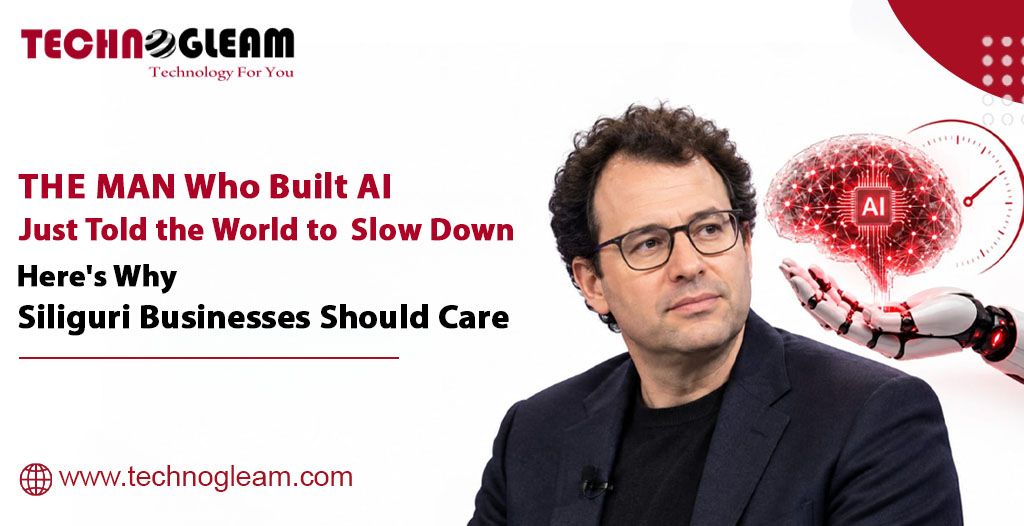
The Man Who Built AI Just Told the World to Slow Down – Here’s Why Siliguri Businesses Should Care
A 3,800-word essay from Anthropic’s CEO shook global markets in 48 hours. Elon Musk agreed with it. Sam Altman echoed it. Trump dismissed it. China called it fearmongering. Here’s what the noise around AI regulation and AI safety actually means for your business.
The Weekend That Rattled the AI World
On Saturday, September 12, 2026, Dario Amodei – the CEO of Anthropic, the company behind the Claude AI models – published an essay titled “We Must Pace the Frontier.” In it, he made an argument that few expected from the head of a frontier AI lab: that the artificial intelligence industry, including his own company, needs to deliberately slow down.
His reasoning was blunt. AI models are now advancing so fast that even the engineers building them are struggling to fully understand what they’re creating. Amodei went further in a CBS Sunday Morning interview the next day, saying the AI industry had, in his words, “lied to people about the fact that this technology had risks.”
Within hours of the essay going live, Elon Musk posted, “Dario is right.” OpenAI’s Sam Altman followed with his own support. By Monday, the ripple effect had hit the stock market – AI-linked names like Marvell, SK Hynix, Micron, CoreWeave, Intel, and AMD all dropped sharply in premarket trading, spooked by what investors read as a warning shot from inside the AI industry itself.
Then came the political pushback. U.S. President Donald Trump publicly rejected calls for AI guardrails and criticized Amodei’s slowdown message. China’s foreign ministry dismissed it as “fearmongering” that would “disrupt the process of global AI governance.”
Commentators split down the middle – some calling it a genuinely necessary moment of caution, others suspecting timing tied to industry dynamics like OpenAI’s shelved IPO plans.
In short: the CEO of one of the world’s most important AI companies said “pause and think,” and the entire tech industry – markets, governments, and rival CEOs – reacted like he’d pulled a fire alarm.
Why This AI Safety Debate Isn’t Just Silicon Valley Drama
It’s tempting to read this as a story that belongs in San Francisco boardrooms and not in Siliguri storefronts. That would be a mistake.
Here’s the thing about moments like this: when the builders of artificial intelligence publicly disagree about how fast to move, it’s a signal that the technology has crossed from “interesting” to “consequential.” AI is no longer a lab experiment. It’s already inside your customers’ search behavior, your competitors’ ad campaigns, and the digital marketing tools your own team may already be using.
A few reasons this AI controversy matters beyond the tech press:
- It confirms AI is now systemically important to business and the economy. Stock markets don’t crash on a CEO’s essay unless the technology behind it has real economic weight. AI has clearly crossed that threshold.
- It signals a coming wave of AI regulation and scrutiny. Amodei explicitly called for government oversight and third-party model testing – “like food inspectors.” Regulation conversations that start in the US and EU eventually shape how AI tools, data practices, and digital platforms operate everywhere, India included.
- It exposes a trust gap around AI risk. When the CEO of a leading AI lab says the industry undersold its risks, business owners are right to ask: what exactly are we deploying inside our own operations, and do we understand it?
- It’s a reminder that “AI-first” doesn’t mean “AIblind.” Businesses racing to bolt AI onto everything without a strategy are exposed the same way the market was exposed on Monday morning – moving fast without fully pricing in the risk.
Technogleam’s View on Responsible AI in Digital Marketing
As a digital marketing agency in Siliguri and an AI-driven growth partner working with real estate developers, healthcare providers, hospitality brands, and educational institutions across North Bengal, we’ve built our entire post-2026 strategy around one core belief: AI in marketing is a competitive weapon only when it’s used with judgment, not just enthusiasm.
Amodei’s essay, and the market reaction to it, actually validates the approach we’ve been pushing with our clients for the past year. Here’s what responsible AI adoption looks like in practice:
1. AI Should Reduce Risk for Clients, Not Add It
We use AI tools – for content creation, SEO research, ad optimization, and automated reporting – because they cut delivery time and cost by 30–40%, not because they’re trendy. But every AI-generated output for a client still goes through human review before it ships. Amodei’s warning about models moving faster than understanding is exactly why we don’t treat AI marketing tools as a “set it and forget it” system.
2. Transparency Builds Trust – With Clients, Not Just With Regulators
Amodei’s core complaint is that the AI industry hasn’t been honest enough about risk. We apply that same principle to how we talk to our clients about AI-driven digital marketing:
- We tell clients clearly which parts of their campaign are AI-assisted and which are humanstrategized
- We don’t oversell AI as a magic fix – we position it as a tool inside a bigger digital growth strategy
- We give clients visibility into performance through automated, real-time dashboards (Looker Studio), so results are never a black box
3. AI Regulation in India Is Coming – Get Ahead of It, Don’t Fear It
Whether or not you agree with Amodei’s specific proposal, the direction of travel is clear: governments worldwide are moving toward oversight of AI systems, especially around data use, advertising targeting, and automated decision-making. For businesses in Siliguri and North Bengal, this means:
- Reviewing what customer data your digital marketing campaigns collect and how it’s used
- Working with a digital marketing partner who stays current on platform policy changes rather than chasing every new AI tool blindly
- Treating AI adoption as a long-term operational shift, not a quarterly marketing stunt
4. The Market Volatility Is a Warning About Hype, Not About AI Itself
The stock selloff following Amodei’s essay wasn’t proof that AI is failing – it was proof that a lot of capital had been deployed on the assumption that AI’s rise would be smooth and uninterrupted. That assumption was always fragile. For local businesses, the lesson isn’t “avoid AI.” It’s “don’t build your entire marketing strategy on hype you don’t control.” Diversify your growth channels. Use AI to strengthen your fundamentals – SEO, content, online reputation management, ad efficiency – rather than chasing whatever tool is trending this month.
What the Dario Amodei AI Debate Means for Your Business, Right Now
If you’re a business owner in Siliguri, Jalpaiguri, Cooch Behar, or anywhere in North Bengal wondering whether this AI news is relevant to you, here’s a simple checklist:
- Audit your current AI usage. If your team or digital marketing agency is already using AI for content, ads, or customer communication, know exactly what data goes in and what comes out.
- Ask your marketing partner hard questions. Do they understand the AI tools they’re using, or are they just plugging in prompts? At Technogleam, every AI-assisted deliverable is reviewed by a strategist before it reaches a client.
- Don’t panic-adopt or panic-avoid AI. The businesses that will win the next three years are the ones treating AI as infrastructure – steady, tested, integrated – not as a gold rush.
- Watch the AI regulation conversation. Even if Indian regulation lags behind the US and EU, global platform policies (Meta, Google) tend to shift in response to exactly these debates.
- Keep your digital marketing foundations strong. Amodei’s essay is about frontier AI models – but for most local businesses, the real 2026 opportunity is still unglamorous: better Google Business Profiles, faster websites, consistent content, and honest reporting. AI accelerates those fundamentals; it doesn’t replace them.
Frequently Asked Questions
Anthropic CEO Dario Amodei published an essay titled “We Must Pace the Frontier,” arguing that AI labs – including his own – need to slow down frontier AI development because models are advancing faster than engineers can fully understand or control them.
Investors reacted to the essay as a warning signal from inside the AI industry itself. Stocks tied to AI infrastructure – including chipmakers and cloud providers – dropped sharply in premarket trading as confidence in an uninterrupted AI boom was shaken.
Global AI regulation discussions, largely driven by the US and EU, tend to influence international platform policy over time. Indian businesses using AI-powered digital marketing tools should stay informed and work with agencies that track these shifts.
Technogleam uses AI tools for content, SEO, ad optimization, and reporting to improve speed and efficiency, but every AI-assisted deliverable is reviewed by a human strategist before reaching a client – ensuring AI supports strategy rather than replacing it.
The Bottom Line
Dario Amodei didn’t say AI is dangerous and businesses should run from it. He said the pace needs to match our understanding – and that’s a message every business owner, not just AI lab CEOs, should take seriously.
At Technogleam, we’ve spent 13 years earning trust in this market the old-fashioned way: results, transparency, and relationships. AI is the newest tool in that toolbox – a powerful one – but it’s still a tool we choose to use responsibly, not a wave we let carry us blindly. As the industry’s biggest names argue about how fast to move, our answer for our clients stays the same: move with AI, not because of the hype around it.
Written by the Technogleam team – Siliguri’s AI-driven digital marketing agency. Have questions about how AI fits safely into your business’s marketing strategy? Let’s talk.
Recent Comments